

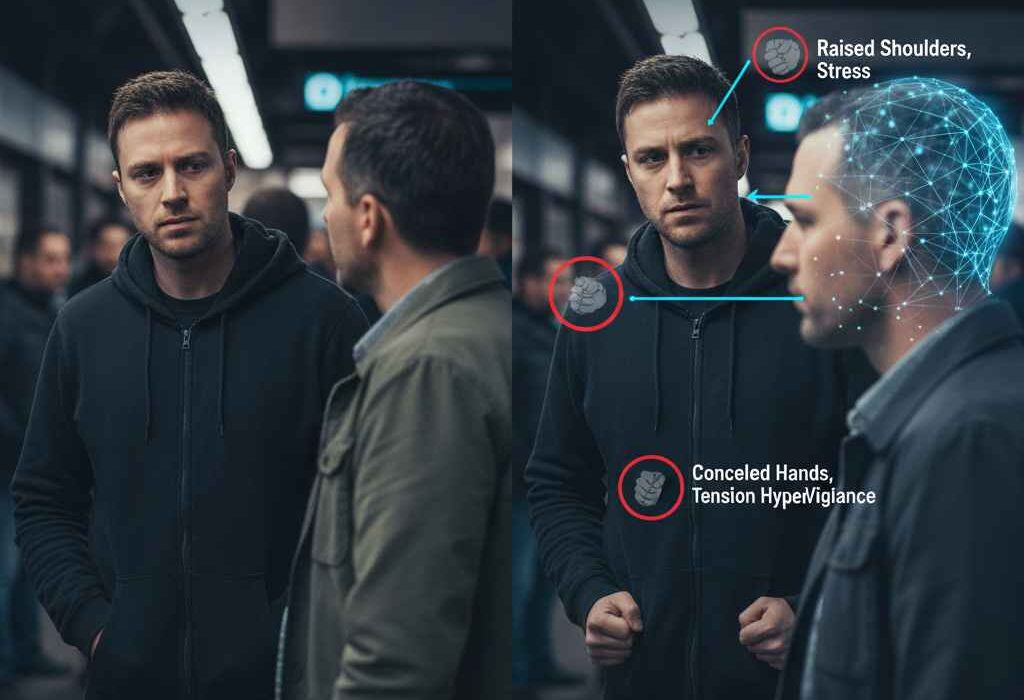
In any high-risk scenario, being able to read the people around you can be just as important as having the right gear. Small teams and tactical operators know that subtle physical cues can reveal intentions before a threat fully manifests. Reading body language isn’t about guessing—it’s about observation, pattern recognition, and situational awareness.
Why Body Language Matters
Threats often reveal themselves before words or actions. A person’s posture, facial expressions, and micro-movements can indicate aggression, fear, or deception. For tactical teams:
- Early detection gives time to react and plan
- Prevents being caught off guard in urban or wilderness environments
- Enhances team safety and operational efficiency
By understanding common signs of stress or aggression, you can proactively manage situations instead of reacting blindly.

Key Body Language Cues to Watch
1. Posture & Stance
- Aggressive or tense individuals often lean forward, tighten shoulders, or clench fists.
- Shifting weight or pacing can indicate agitation or pre-assault readiness.
2. Eye Contact
- Avoidance or over-fixation can signal different intentions:
- Too little eye contact may indicate fear or deception
- Intense staring can be a challenge or threat
3. Hand Movements & Gestures
- Concealed hands may indicate a hidden weapon or attempt to hide intentions
- Rapid or jerky movements often indicate nervousness or pre-attack tension
4. Facial Expressions
- Subtle changes—tightened lips, flared nostrils, or rapid blinking—can reveal stress or aggression.
- Microexpressions often appear for a fraction of a second but are highly telling.
5. Proximity & Space
- Individuals encroaching on personal space may be testing boundaries or preparing to act
- Retreating or maintaining unusual distance can indicate caution or concealment of intent
How to Train Your Observational Skills
- Practice Situational Awareness Daily
- Scan your environment constantly, noting behaviors without staring
- Use casual observation in public spaces to build pattern recognition
- Focus on Baselines
- Everyone has normal behavior. Compare unusual actions to their baseline to detect anomalies
- Combine Multiple Cues
- A single gesture may be harmless; a combination of posture, eye contact, and hand movements signals heightened risk
- Trust Your Instincts
- Gut feelings often arise from subconscious recognition of multiple subtle cues. Never ignore them
Integrating Body Language with Tactical Response
- Team Communication: Share observed cues with your team quickly and discreetly
- Preemptive Positioning: Adjust stance, spacing, or exit routes based on potential threats
- De-Escalation: Early detection allows for verbal or tactical de-escalation before engagement
- Backup Plans: Always have a plan for extraction, reinforcement, or defensive maneuvers if needed
Conclusion: Awareness Is Your First Line of Defense
Reading body language transforms awareness into actionable intelligence. By observing posture, gestures, eye contact, and proximity, you can spot threats before they strike. For tactical teams, this skill reduces risk, improves decision-making, and ensures safety in both urban and field operations. Combine keen observation with training and your team becomes a step ahead—always prepared, always alert.