

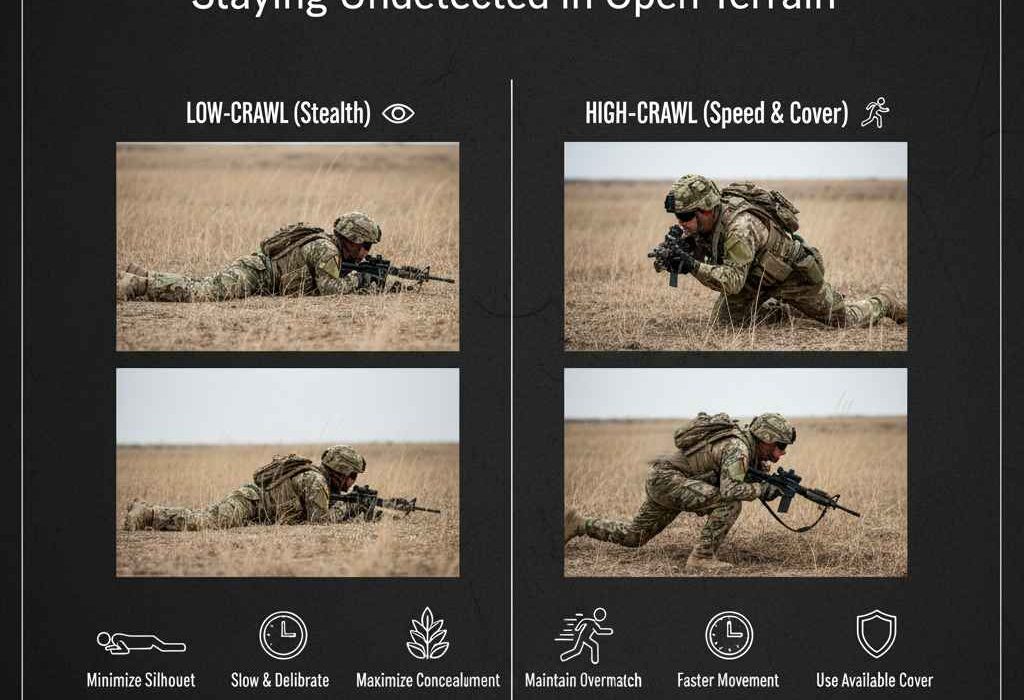
Moving across open ground without being seen or heard is one of the toughest skills to master. Trees, rocks, and buildings give cover in forests or towns; on plains, deserts, or fields you’re exposed. That’s where low-crawl and high-crawl techniques matter: they let you close distance, cross gaps, or reposition with a much lower chance of detection — while reducing noise, silhouette, and movement signature. Use them for reconnaissance, evasion, or simply to cross dangerous ground safely.
This post focuses on the practical principles, gear and body considerations, when to use each crawl, drills to get better, and safety/ethical reminders. Read it, practice safely, and keep it lawful.
When to use each crawl
Low-crawl (very low, near the ground)
- Best for small distances where concealment is critical (approaching a hidden objective, moving under sightlines, or crossing a short exposed stretch).
- Use when terrain is soft or offers partial cover (tall grass, shallow ditches) and you can accept very slow progress.
- Trade-off: excellent concealment; higher physical strain and slower speed.
High-crawl (lowered, forward-press crawl)
- Good for longer moves where complete belly contact isn’t needed but you still must reduce silhouette (moving under tree lines, between low shrubs, or across uneven ground).
- Faster than low-crawl, less taxing, and allows quicker transition to movement or a firing position if needed.
- Trade-off: more visible than low-crawl but maintains better tempo and vision.
Choose based on threat level, distance, ground conditions, and how quickly you must move.
Core principles (what actually matters)
- Keep a low silhouette: The lower your profile relative to observers and the horizon, the less likely you are to be seen. Use terrain undulations and vegetation to your advantage.
- Minimize noise: Secure loose gear, tape noisy buckles, compress fabrics that rub, and route straps tight to avoid rattles.
- Move slowly and deliberately: Fast jerky movement attracts attention; steady rhythm blends with background motion.
- Use natural lines: Move along depressions, behind humps, or in the shadow of terrain features — these break your outline.
- Eyes forward, not down: Practice feeling the ground with minimal head movement; scanning without rising preserves concealment.
- Control respiration: Loud breathing is surprisingly audible in quiet environments. Slow, controlled breaths reduce sound and panic.
- Plan transitions: Know where you’ll stop and how you’ll stand up or sprint if needed — transitions are the most dangerous moments.
Gear and clothing tips
- Low-profile clothing: Earth tones, non-reflective fabrics, and pattern-matched gear help. Avoid shiny hardware.
- Secure loose items: Use elastic retention, tape, or paracord to secure pouches, buckles, and straps.
- Knee & elbow protection: Thin pads or layered cloth reduce abrasion when crawling over rough ground.
- Gloves: Thin, grippy gloves protect hands while maintaining dexterity and ground feel.
- Light discipline: Use no white light; if necessary, dim red or green light for reading maps at stops.
Keep kit light for long crawls; every kilogram increases fatigue and decreases stealth.
Movement safety and medical concerns
- Avoid crawling over thorny, glass-strewn, or heavily contaminated ground without protection.
- Maintain circulation: prolonged static positions lead to numbness — shift weight periodically and check extremities.
- Watch for hypothermia in cold, moist conditions; being low to the ground can increase heat loss.
- Keep a basic first-aid kit easily accessible — abrasions and infections are common with prolonged ground contact.
- If you must crawl through water or mud, plan for drying and insulation at the next stop.
Safety-first: if movement risks more harm than staying put, pick a different plan.
Drills to practice (safe, repeatable)
- Controlled distance drills: Mark 10–30m lanes and practice low- and high-crawls for time and smoothness; focus on rhythm and minimal head lift.
- Noise discipline drill: Wear full kit and have a partner walk the lane listening for gear noise — secure anything that rattles.
- Transition practice: From crawl to stand and bolt — rehearse slow, deliberate transitions and quick rises in a safe area.
- Fatigue simulation: Add light weight and repeat crawls to build endurance and learn when technique breaks down.
Always practice in a safe, legal area (training ground or private land with permission). Don’t use real operations or active environments for untrained experimentation.
Ethical & legal reminders
These techniques are survival and recon skills — they can also be misused. Use them only for lawful, ethical purposes: training, survival, lawful security operations, or recreation. Avoid using concealment techniques to trespass, evade lawful authorities, or commit crimes. If you train others, emphasize safety, legal limits, and responsible use.
Final thought
Low- and high-crawl skills turn open terrain from a vulnerability into an opportunity. They demand patience, practice, and respect for your environment and teammates. When you combine the right mindset, controlled movement, gear discipline, and safety habits, you’ll move quieter, flatter, and smarter across exposed ground — and that can make all the difference in a mission or survival scenario.